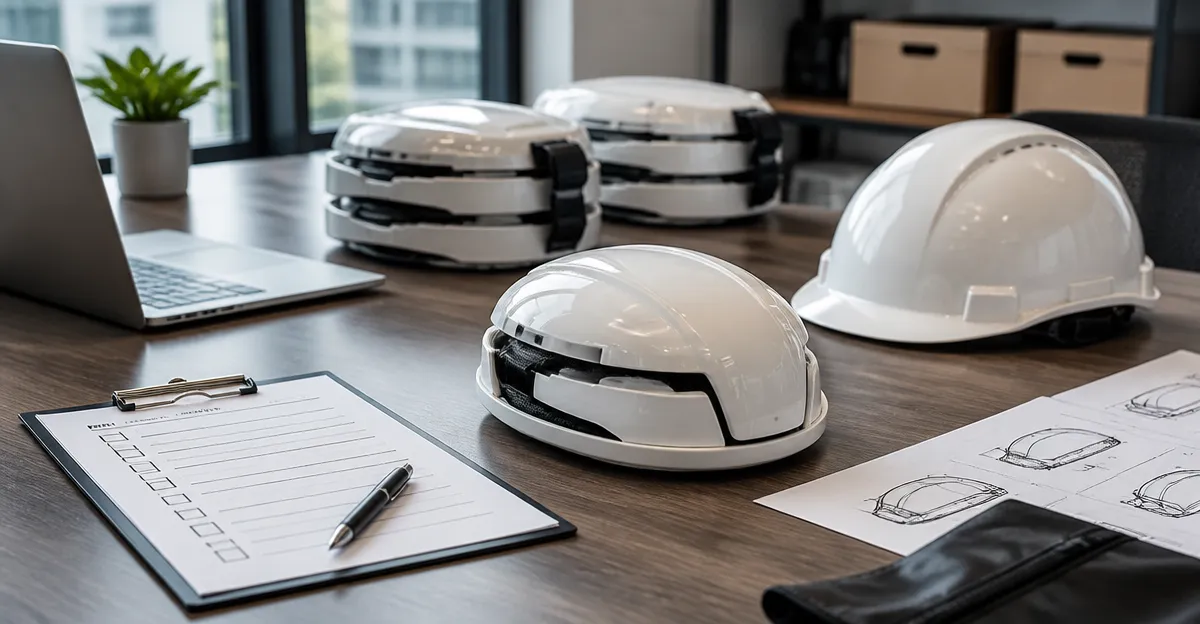
Corporate Procurement Checklist for Bulk Foldable Helmets: A 10‑Step Guide to Sourcing, Compliance, Quality & Cost Savings
Introduction
Corporate procurement teams are increasingly tasked with providing safe, portable head protection for employees who commute by bike, scooter or skateboard. This guide explains how to source bulk foldable helmets while meeting regulatory requirements, maintaining high quality, and achieving measurable cost savings. Readers will learn a ten‑step checklist, discover key product attributes, and understand how to compare leading models such as the Closca Foldable Helmet, the FEND Super Plus Folding Helmet, the Overade Plixi Folding Helmet, the FEND One Folding Helmet, and the Closca Folding Helmet with Visor. Each product is referenced at its first appearance to facilitate quick navigation.
The checklist is organized into logical phases: requirement definition, compliance verification, supplier assessment, cost analysis, and post‑purchase validation. By following these steps, procurement professionals can reduce risk, negotiate better pricing, and ensure employee safety across multiple locations.
Background / Context
Urban mobility programs have expanded rapidly as corporations encourage greener commuting options. In many jurisdictions, helmets are mandatory for cyclists and electric scooter riders, making head protection a compliance issue for employers. Foldable helmets address two common challenges: storage constraints in office lockers and the desire for a sleek, professional appearance. Unlike traditional helmets, foldable designs compress to a fraction of their original volume, allowing them to be stored in briefcases, backpacks, or shared workspaces.
Key standards governing helmet safety include the United States Consumer Product Safety Commission (CPSC) regulation and the European EN1078 standard. Both require impact attenuation, retention system performance, and field of vision criteria. Corporate buyers must verify that each model meets or exceeds these benchmarks before committing to large orders.
Cost considerations extend beyond list price. Procurement teams should evaluate warranty terms, replacement programs, and the total cost of ownership, including accessories such as carrying bags or replacement lights. Bulk purchasing often unlocks volume discounts, but only when the supplier’s pricing structure is transparent.
Step 1: Define Scope and Volume Requirements
The first step is to establish the number of helmets needed, the intended user groups, and the distribution timeline. Create a spreadsheet that captures head‑size demographics, preferred colors, and any special features such as integrated lights or visors. For example, a technology firm with 200 employees may allocate 120 medium‑size helmets, 60 large, and 20 small based on a head‑circumference survey.
Document the anticipated storage locations and the frequency of helmet turnover. High‑turnover environments benefit from models that fold in under one second, such as the Closca Foldable Helmet, which folds to a height of 6.5 cm in less than a second. Knowing these details early helps narrow the product list.
Step 2: Verify Safety Certifications and Compliance
Every candidate must hold valid CPSC and EN1078 certifications. Review the certification numbers supplied by the manufacturer and request third‑party test reports if they are not publicly available. The FEND Super Plus Folding Helmet explicitly states compliance with both US CPSC and EU EN1078 standards, providing a clear compliance baseline.
In addition to impact protection, assess auxiliary safety features such as integrated LED lights. The FEND Super Plus includes removable 30‑lumen front and rear LEDs with a 15‑hour runtime, enhancing visibility in low‑light conditions. Verify that any electronic components meet IPX6 waterproofing to survive rain exposure.
Step 3: Evaluate Product Features Relative to Corporate Needs
Feature evaluation should align with the organization’s mobility policy. Key attributes include:
- Foldability speed and final volume (e.g., Overade Plixi folds in 2 seconds and reduces volume by one‑third).
- Weight range for comfort during long commutes (Closca Foldable Helmet weighs 250–280 g).
- Adjustability mechanisms that reduce fit‑adjustment time (FEND One utilizes a Fit Dial System).
- Additional accessories such as visors, carrying bags, or replacement‑light programs.
Prioritize helmets that offer a warranty covering manufacturing defects. The Closca Foldable Helmet provides a three‑year warranty, while the FEND line includes a 30‑day money‑back guarantee plus an Accident Replacement Program.
Step 4: Conduct Supplier Due Diligence
Assess the supplier’s financial stability, manufacturing capacity, and track record with corporate clients. Request references from other enterprises that have placed bulk orders. Verify that the supplier can meet the required delivery schedule, especially if the helmets need to be shipped to multiple office locations.
Check for any existing certifications such as ISO 9001 for quality management. A supplier that adheres to ISO standards is more likely to maintain consistent product quality across large batches.
Step 5: Perform Cost‑Benefit Analysis
Calculate the total cost of ownership (TCO) for each model. Include list price, bulk discount tiers, shipping fees, warranty extensions, and any optional accessories. For instance, the Closca Foldable Helmet is priced at $89.90 per unit, while the FEND Super Plus commands $139.00 but includes integrated LED lights that might eliminate the need for separate lighting accessories.
Factor in potential savings from reduced workplace accidents. A study by the National Safety Council indicates that every $1 million saved in accident costs corresponds to roughly $10 million in productivity gains. High‑quality helmets with proven safety records can contribute to these savings.
Step 6: Request Samples and Conduct Fit Testing
Before finalizing a bulk order, obtain a sample of each shortlisted helmet. Conduct fit testing with a representative group of employees to ensure comfort across the size spectrum. The rear adjustment system of the Closca Foldable Helmet, which uses elastic bands, allows a one‑time adjustment that can be verified during this phase.
Document feedback on ventilation, weight perception, and ease of folding. Employees who commute in hot climates may prioritize ventilation; the FEND One’s breathable design and multiple vents address this need.
Step 7: Negotiate Terms and Volume Discounts
Leverage the data gathered in previous steps to negotiate favorable pricing. Suppliers often provide tiered discounts for orders exceeding 100 units. Request a detailed price break schedule and inquire about bundled accessories such as carrying bags or replacement light kits.
Ensure that the contract includes service level agreements (SLAs) for delivery timelines, defect replacement, and post‑sale support. The FEND Accident Replacement Program, which offers free replacement after an accident, can be a valuable clause to incorporate.
Step 8: Finalize Procurement Documentation
Prepare a purchase order (PO) that references the agreed‑upon specifications, pricing, warranty, and delivery schedule. Include a compliance checklist that confirms each helmet meets CPSC and EN1078 standards, has passed internal fit testing, and carries the appropriate warranty.
Attach a risk‑mitigation annex that outlines procedures for handling defective units, managing returns, and documenting any incidents involving the helmets.
Step 9: Implement Distribution and Training
Develop a distribution plan that aligns with office locations and employee onboarding schedules. Provide a brief training session that covers proper helmet adjustment, folding technique, and maintenance. Highlight unique features such as the FEND Super Plus LED activation method (press and hold for 1 second) to ensure employees use the safety enhancements correctly.
Supply each employee with a quick‑reference card that includes the corporate warranty contact and the procedure for reporting damage.
Step 10: Monitor Performance and Conduct Periodic Reviews
After deployment, track key performance indicators (KPIs) such as helmet usage rate, incident reports, and employee satisfaction scores. Conduct quarterly reviews with the supplier to discuss any quality concerns or opportunities for further cost reduction.
Use the data to refine future procurement cycles. Continuous improvement ensures that the organization remains compliant, cost‑effective, and supportive of sustainable commuting initiatives.
Comparison / Selection Guide
| Model | Price (USD) | Weight (g) | Fold Reduction | Safety Certifications | Key Extras |
|---|---|---|---|---|---|
| Closca Foldable Helmet | 89.90 | 250‑280 | 55% (6.5 cm height) | CPSC, EN1078 | 3‑year warranty, elastic rear adjustment |
| FEND Super Plus | 139.00 | ~300 | 50% | CPSC, EN1078 | 30‑lumen front/rear LEDs, USB‑C rechargeable |
| Overade Plixi | 129.00 | 467 | 66% (volume divided by 3) | CPSC | removable sun/rain cap, 14 vents |
| FEND One | 119.00 | ~310 | 50% | CPSC, EN1078 | Fit Dial System, Red Dot award |
| Closca Folding Helmet with Visor | 129.00 | 250‑280 | 55% | CPSC, EN1078 | Reflective visor, 3‑year warranty |
Best Practices & Tips
- Standardize size ranges across all locations to simplify inventory management.
- Leverage the supplier’s accident replacement program as a risk‑transfer mechanism.
- Include a small maintenance kit (cleaning wipes, spare pads) in each distribution package.
- Track serial numbers or batch codes to facilitate warranty claims.
- Encourage employees to store helmets in the provided carrying bag to protect the folding mechanism.
- Review local regulations annually; some jurisdictions update helmet standards.
Frequently Asked Questions
- 1. Do foldable helmets provide the same level of protection as traditional helmets?
- Yes. When unfolded, models such as the Closca Foldable Helmet and the FEND One meet CPSC and EN1078 impact standards, offering protection equivalent to conventional helmets.
- 2. Can the integrated LEDs on the FEND Super Plus be replaced if they fail?
- The LED modules are detachable and the manufacturer provides replacement units at a nominal cost. The warranty covers defects for the first 30 days.
- 3. What is the recommended storage method for bulk helmets?
- Store helmets in a climate‑controlled area, preferably in their original packaging or a soft carrying bag to prevent scratches on the polycarbonate shell.
- 4. How does the Fit Dial System improve fit consistency?
- The dial allows incremental adjustments in millimeter increments, ensuring a repeatable fit across multiple users without the need for repeated strap tightening.
- 5. Are there tax advantages to bulk purchasing safety equipment?
- In many jurisdictions, safety equipment is classified as a deductible business expense. Consult a tax professional to confirm eligibility.
- 6. What warranty coverage should a corporate buyer expect?
- Most manufacturers offer a minimum of 30 days money‑back and a longer warranty for manufacturing defects; for example, Closca provides three years, while FEND includes an accident replacement program.
- 7. How can I verify that a helmet complies with both CPSC and EN1078?
- Request the certification numbers from the supplier and cross‑reference them with the official databases maintained by the U.S. Consumer Product Safety Commission and the European Committee for Standardization.
Conclusion
Corporate procurement of bulk foldable helmets requires a disciplined approach that balances safety, cost, and user experience. By following the ten‑step checklist, evaluating certifications, comparing key features, and negotiating robust service terms, organizations can protect their workforce while supporting sustainable commuting initiatives. The featured helmets demonstrate that high‑quality protection can coexist with convenience and style, making them suitable choices for a modern corporate mobility program.
Products Featured in This Guide
Closca Foldable Helmet
Price: $89.90 | Rating: 4.5/5 (464 reviews)
Featured for its rapid 1‑second fold, lightweight polycarbonate shell, and three‑year warranty, making it ideal for large‑scale corporate roll‑outs.
FEND Super Plus Folding Helmet
Price: $139.00 | Rating: 4.5/5 (85 reviews)
Featured for its integrated 30‑lumen LED lights, smart‑fold technology, and accident replacement program, providing added visibility for night commuters.
Overade Plixi Folding Helmet
Price: $129.00 | Rating: 4.5/5 (310 reviews)
Featured for its three‑second fold, removable sun/rain cap, and 14 ventilation channels, catering to users who value adaptability across multiple modes of transport.
FEND One Folding Helmet
Price: $119.00 | Rating: 4.5/5 (327 reviews)
Featured for its award‑winning Red Dot design, Fit Dial System, and robust ABS/PC construction, offering a premium yet cost‑effective option for corporate fleets.
Closca Folding Helmet with Visor
Price: $129.00 | Rating: 5/5 (1 review)
Featured for its reflective visor and award‑winning design, enhancing visibility for employees who commute during dawn or dusk hours.